
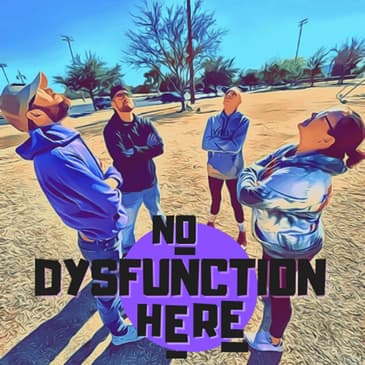
In episode 7, we discuss a little about parenting, and how the role of discipline portrays a constant question in our parenting and coparenting lives.
[00:00:00] Ok ok, ready? Ok!
[00:00:03] Four parents nine kids two houses, They didn't really wanna talk about this,
[00:00:09] Four parents nine kids I'm queer.
[00:00:11] One thing's clear, there's no dysfunction here, Four parents nine kids two houses,
[00:00:17] They didn't really wanna talk about this, Four parents nine kids I'm queer,
[00:00:22] one thing's clear, there's no dysfunction here.
[00:00:38] It's a stiff cheer dance. Good dance.
[00:00:41] That's great. It's been a little minute and we're out here ready to do it.
[00:00:45] What were we gonna talk about today? Can you see the fridge behind me?
[00:00:48] I got a new fridge. Yeah, I can see the fridge.
[00:00:51] It's a galang's.
[00:00:53] Is that French?
[00:00:55] Must be, because it was made in China.
[00:00:58] Fragili.
[00:01:00] Must be Italian.
[00:01:03] Fragili.
[00:01:03] The Christmas Story was made in the year I was born and I think that's special.
[00:01:08] I watched it for the very first time with Jake.
[00:01:11] Really?
[00:01:12] Really?
[00:01:12] Yes.
[00:01:13] Wow!
[00:01:15] Yeah, we just met last year.
[00:01:16] Have you not been listening to our episodes?
[00:01:18] I didn't know it was right when you met, that was my bad.
[00:01:20] Well, true.
[00:01:21] Alright.
[00:01:22] That is a classic man, I love that movie so much.
[00:01:25] I cry every time, I laugh every time, I relate so much.
[00:01:28] Which, now that you mention it, the first time I saw it was because Toby showed it to me.
[00:01:33] Oh, really?
[00:01:34] Yeah, I never saw it before then.
[00:01:35] That is bananas!
[00:01:36] When's the wedding?
[00:01:39] I'm scared.
[00:01:40] I'm surprised, I didn't realize.
[00:01:41] Yeah, true.
[00:01:42] Congratulations.
[00:01:43] So what-
[00:01:43] Yes, you're welcome everybody.
[00:01:44] What Christmas movie did y'all grow up on then?
[00:01:47] Oh my gosh, some good ones.
[00:01:48] Dominic the Donkey?
[00:01:49] Okay.
[00:01:50] What?
[00:01:50] I've never even heard of it.
[00:01:51] The Ham's Eyes?
[00:01:53] Is that one of those like VeggieTales Bible?
[00:01:56] No, Dominic the Donkey.
[00:01:57] No, I've heard Dominic the Donkey.
[00:01:59] It's Dominic the Donkey.
[00:02:01] I've never heard of it.
[00:02:03] It's a Christmas song.
[00:02:03] We should find this.
[00:02:04] I've never heard it and I'm 10% sure you're making it up on that.
[00:02:07] Yeah, I feel like it's similar to Sam Diehards at Christmas.
[00:02:11] Wait, it is.
[00:02:12] Wait, that's episode.
[00:02:14] Conversation for a different day.
[00:02:17] I was a big fan of Muppets Christmas Carol, but I love Muppet movies.
[00:02:22] I think they're so funny.
[00:02:23] They make me laugh.
[00:02:25] Yeah, they are pretty clever.
[00:02:26] I was introduced to Muppet movies by youth.
[00:02:29] That is true.
[00:02:30] Nothing, I've always said nothing will attract a woman faster than Muppet movies.
[00:02:36] It worked.
[00:02:37] Yeah.
[00:02:39] One of my best friends the other day, I was introducing him to this band called the Backseat Lovers.
[00:02:47] And it was just the very beginning of this specific song, but he's like, is that Kermit the Frog?
[00:02:54] And I was just stunned in shock and disappointment and sadness.
[00:03:01] He was like, no.
[00:03:02] I was tongue-tied.
[00:03:03] I had no idea.
[00:03:04] And I was trying to listen for it.
[00:03:06] Like, does he really sound like Kermit?
[00:03:08] He doesn't.
[00:03:08] He doesn't really sound like Kermit.
[00:03:10] Does he?
[00:03:11] I don't think so.
[00:03:12] So are you guys still friends?
[00:03:14] Well, yeah.
[00:03:15] Yes, yes.
[00:03:16] Dang.
[00:03:16] I'm not 100% recovered.
[00:03:18] Yeah.
[00:03:18] Sure.
[00:03:18] It's going to take some time.
[00:03:20] It's more superficial now.
[00:03:21] Yeah.
[00:03:22] Yeah.
[00:03:23] We'll make it.
[00:03:24] It's painful.
[00:03:24] That's good.
[00:03:25] I'm sorry.
[00:03:26] That's good.
[00:03:26] What are we talking about today?
[00:03:29] Speaking of pain, we kind of discussed, we really didn't discuss much about what to talk
[00:03:37] about, but I did throw out an idea.
[00:03:39] Are we feeling that idea?
[00:03:40] Yeah.
[00:03:40] Let's do it.
[00:03:41] I love it.
[00:03:42] What was it?
[00:03:43] I know Jake.
[00:03:44] I'm trying to remember.
[00:03:45] Yeah, that's right.
[00:03:46] That counts.
[00:03:46] It's something to do with parenting.
[00:03:48] Yes.
[00:03:48] We're getting there.
[00:03:50] Children.
[00:03:51] Well, AJ and I were just talking last night just about the idea of wanting to be kind and
[00:04:00] gentle and loving all the time, but where does the role of parenting and sternness and discipline
[00:04:11] and how do we all navigate that?
[00:04:15] And I don't know.
[00:04:16] I just think that none of us wants to be the bad guy, but is it always bad to be the bad guy
[00:04:23] or is it necessary as parents to sometimes be the bad guy?
[00:04:27] And when are those situations?
[00:04:30] And I don't know.
[00:04:31] We just thought we could discuss.
[00:04:34] I love it.
[00:04:35] That's great.
[00:04:36] I think there are so many things there to unpack.
[00:04:41] Yeah.
[00:04:42] Because there are so many different scenarios and instances.
[00:04:45] Like when you mentioned the word consequences, the first thing I thought was like, man, not
[00:04:49] even just consequences, but like just like teaching moments with your kids where you feel like,
[00:04:54] okay, I feel like I want to impress upon them something I learned that was helpful to me
[00:05:01] or was taught to me, or I really don't want to impress upon them, you know, something.
[00:05:08] And it's so tricky sometimes to know because I do, like I do.
[00:05:13] I feel like it is appropriate as a parent.
[00:05:15] Like it's just part of the natural cycle of life that like you're not always pleasant.
[00:05:21] You're not always going to be rainbows and giggles.
[00:05:25] Like it's important that with some lessons and some things and just some situations in life
[00:05:31] that you have to have a different mode or like a different energy around what you're
[00:05:38] trying to express and what you're trying to get across.
[00:05:41] And it changes with different ages and it probably changes with different children, like unique
[00:05:47] personalities.
[00:05:48] And like some person might respond well to one form of expression and some person might respond
[00:05:56] well to a different form of expression.
[00:05:58] And so my mind's already just a melted mess.
[00:06:01] I'm like, I don't know.
[00:06:02] I don't know the answers.
[00:06:03] Don't ask me.
[00:06:03] Don't come back to me.
[00:06:05] I'm just going to keep thinking about it.
[00:06:08] I agree 100%.
[00:06:09] I feel like based on our upbringing from our parents, like, you know, you know, for my
[00:06:18] mom and dad, they were very, very different.
[00:06:20] But then I became a parent and I parented my two kids and then I met Jake.
[00:06:25] But still in the back of my mind, I'm like harshness.
[00:06:28] Like I'm not, I didn't spank my kids, but I had an extremely angered voice.
[00:06:33] Like my mom voice where I clenched my teeth and I'm like, do you hear what I'm saying?
[00:06:37] Like it was, I wanted to get their attention and I felt the louder I was or the angrier
[00:06:43] I sounded, it would be like, oh my gosh, mom's talking to me right now.
[00:06:47] And it was for me, and I'm still trying to wrap my mind around this whole idea of how
[00:06:53] to be a good parent, but it's, you know, I met Jake and it was like listening to him
[00:06:57] when he was disciplining the kids was very different than how I was disciplining my children.
[00:07:02] And I kind of had, and I'm still learning, like, am I not going to scream?
[00:07:06] Am I not going to like, well, my hands up in the air and become like this awful, like
[00:07:11] tyrant or whatever.
[00:07:12] But, um, I know I'm drastically changing over the last eight years of being in a family
[00:07:19] of six.
[00:07:19] And it's just like, I don't know the right or wrong reason.
[00:07:22] I don't know it's good, but I know it's still, you want to be kind and you want to make
[00:07:28] sure you're not saying hateful words and remembering what you said.
[00:07:34] Because when you walk away from whatever you're saying to your kids, like that might be echoing
[00:07:39] in their ears and you're walking away like, done.
[00:07:42] Drop the mic.
[00:07:43] Yep.
[00:07:44] And they're like, what the fuck just happened?
[00:07:46] Yeah.
[00:07:48] So it's, it's not easy.
[00:07:50] It's so hard.
[00:07:51] But like AJ said, like, I'm still like in a whirlwind of even how to answer this question.
[00:07:56] But I think, I don't, I don't know the right or wrong.
[00:08:00] I just hope I'm doing a good job.
[00:08:03] You are too far.
[00:08:05] I think it's really fluid.
[00:08:07] I think even us as individual parents, you know, just constantly changing what we believe
[00:08:14] in this regard, you know, because every parenting experience is a learning experience for the
[00:08:21] parent and the child or children.
[00:08:24] And, uh, and so we learn from it and we learn, you know, I, after I talk to my kids, I, that's
[00:08:33] all I can think about is how did that go?
[00:08:37] What do I already feel like I did or said wrong?
[00:08:40] What do I feel like I could have done better?
[00:08:44] Um, I just start beating myself up about any of the potentially negative that went on.
[00:08:50] And so I think my tactics change over time, but, um, just based on my own personal experiences
[00:09:00] of parenting as I go.
[00:09:01] So now I'm beating a dead horse, but, um, but in general, I don't like yelling at my kids
[00:09:08] and I don't want to.
[00:09:10] Um, I think when, uh, safety is or urgency or, uh, like you need to demonstrate urgency
[00:09:19] because of the importance and you don't feel like you're getting it.
[00:09:25] Like I, if I'm on point with my game in this, in, in this regard, like I attempt number one
[00:09:33] of this subject is starts and ends with kindness and it's all kindness and love, um, and patience
[00:09:41] all throughout.
[00:09:43] And if I'm on my game, then attempt number two for the same category, the same, same type
[00:09:52] of thing is still kind and patient.
[00:09:54] And I feel like the third time I'm like, okay, we've been through this twice.
[00:10:00] I'm not seeing the change.
[00:10:03] And now I have to, I feel like I need to deliberately be stern.
[00:10:11] You know, I would call it mean.
[00:10:13] I would call it angry, you know, just demonstrate like, okay, I gotta get loud.
[00:10:18] But do I have to get loud for the entire experience?
[00:10:21] Or do I just need to bark for a few seconds at the beginning?
[00:10:25] And that's like a huge thing I've learned from Jake's parenting is I feel like in the
[00:10:31] past, prior to me being a part of this family, I would probably go out on a huge tangent and
[00:10:37] scream and yell.
[00:10:38] And like the Italian in me comes out and my hands are da, da, da, da.
[00:10:42] And I hope I've progressed to what I believe I've progressed.
[00:10:46] It's like, even if I'm really pissed off at something one of the kids did, like I might
[00:10:50] come at them like super sharp.
[00:10:53] But now I'm in an understanding of, okay, I'm going to keep my cool because if I'm screaming
[00:10:58] and yelling at my kids, then they're not hearing me anymore.
[00:11:01] They've completely walled up and they just, it's like the Muppets, like wah, wah, wah, wah,
[00:11:06] wah, like they're not listening anymore.
[00:11:09] Goes in one ear and out the other.
[00:11:10] 100% and it's a huge progression for me and it'll be that way until like I'm 80 and my
[00:11:17] kids are like showing me my great grandkids.
[00:11:19] But it's big, you know what I mean?
[00:11:24] To go from one extreme to the next and seeing how receptive those people are that you're
[00:11:30] having to like tell them like, hey, you did something really screwed up.
[00:11:35] Do you see what you did?
[00:11:36] And instead of being like, rah, rah, rah, rah, like, you know, I get that because I feel
[00:11:41] I would be the same way.
[00:11:42] Like if I did something wrong and someone's screaming like dragon fire at me, then I'm probably
[00:11:46] going to be like, whoa.
[00:11:48] But if you're like, hey, you screwed up and let's talk about it.
[00:11:54] And it's like that even like energy.
[00:11:57] No one's too high.
[00:11:58] No one's too low.
[00:11:59] Like that's what I'm learning.
[00:12:00] And I see that with all of our kids.
[00:12:02] But like what AJ said in the beginning, every single one of them are different.
[00:12:06] So I'm going to go, you know, I Jonah a different way than I'm going to go at Anna.
[00:12:10] Then I'll go like at Mason or Reagan or Chan.
[00:12:13] And like it's all their personalities.
[00:12:15] It's like developing that, like what makes sense.
[00:12:18] And it's still, it's a learning process.
[00:12:20] Ew.
[00:12:21] Forever.
[00:12:22] It's been a huge struggle in my parenting journey to figure out how to be calm and be effective.
[00:12:32] You know?
[00:12:33] For sure.
[00:12:34] And, you know, in my childhood, that was not a thing.
[00:12:39] I was never spoken to calmly or rarely.
[00:12:42] And I didn't know any other way.
[00:12:44] And Jake really helped me too.
[00:12:46] This isn't really a story about parenting, but about partnership.
[00:12:51] But when we were first married, I think Chandler was probably a baby.
[00:12:54] But we were in St. George visiting my dad.
[00:12:57] And we got in an argument and I have no idea what it was about.
[00:13:02] But I didn't understand that there was a way to communicate within a marriage that wasn't screaming.
[00:13:10] If there was a disagreement, it was a fucking fight.
[00:13:13] And that is all I knew.
[00:13:15] And I was ready to do it and win.
[00:13:17] You know?
[00:13:18] Like, and so I remember being on the stairs of my dad's house.
[00:13:22] I was at the top of the stairs.
[00:13:23] He was at the bottom of the stairs.
[00:13:24] And he was, like, walking down the stairs and I was following him and I was, like, screaming at him.
[00:13:28] And he just turned around.
[00:13:30] Do you remember this?
[00:13:31] And he was, like, stop.
[00:13:32] Not specifically.
[00:13:33] I remember this story.
[00:13:35] He's, like, you will not speak to...
[00:13:39] We will not do this in our marriage.
[00:13:41] This will not be a thing.
[00:13:42] He literally just, like, put me in my place and was, like, this is not how we are doing things.
[00:13:49] And we really didn't scream at each other, like, after that much at all.
[00:13:53] Like, we had a couple arguments around the divorce.
[00:13:56] But, you know, he really helped me.
[00:13:58] But as far as parenting goes, I would feel like a failure every single time my children misbehaved.
[00:14:08] And that's even toddlers.
[00:14:09] Like, a two-year-old does something they're not supposed to do and I feel like I've done something bad.
[00:14:14] And so then I'm overly dysregulated wanting to correct it because it's just so...
[00:14:22] It was so toxic and difficult.
[00:14:24] And then I would cry myself to sleep most nights.
[00:14:27] And I would go into the bathroom.
[00:14:28] I'd lock myself in the bathroom.
[00:14:29] And I would cry and cry because I just felt so bad for losing my patience again and again.
[00:14:35] And I just couldn't get it under control.
[00:14:37] And it was such a struggle.
[00:14:40] And one thing that really helped me was learning to count to ten, which is the dumbest, most basic thing.
[00:14:47] But if I felt that dysregulation, I learned to recognize it and count to ten.
[00:14:53] And then sometimes I would count down to ten.
[00:14:56] You know, like, one thing that would really fuck me up was when my kids couldn't find their shoes and it was time to go to church.
[00:15:02] And I'm like, I told you!
[00:15:04] Don't have your shoes on!
[00:15:06] Because I'm like, if we're late for church, everyone's going to think I'm a failure.
[00:15:12] And I can't be a failure.
[00:15:14] It's not an option.
[00:15:15] It was so bad.
[00:15:17] You know?
[00:15:18] And so when I realized, okay, my child doesn't have his church shoes, it's like, oh, this is one of those moments.
[00:15:24] One, one thousand.
[00:15:26] And it really helped me little by little.
[00:15:29] It didn't work every time, but I chipped away at it.
[00:15:32] And I'm still not perfect.
[00:15:33] That's for damn sure.
[00:15:34] But that little trick really helped me as a young mom.
[00:15:39] I love it.
[00:15:40] I think that what the line of work.
[00:15:43] I think the congregation needed to learn, all 300 of them, not to stare at the poor mom with four kids walking in five minutes late.
[00:15:52] Totally.
[00:15:53] It was the congregation's fault, not your fault.
[00:15:55] Very good point.
[00:15:57] That expectation shouldn't be there.
[00:15:58] Keep facing forward, jerks.
[00:16:00] Yeah.
[00:16:00] I think what you're describing, too, and what kind of everyone described falls under the umbrella of self-awareness.
[00:16:09] And when I think about all four of us as parents and the conversations we have and the people just that we are individually, but also as a co-parenting team, is that we are constantly re-evaluating and assessing, which is just a form of self-awareness about how we're doing and what we can do different and what can be better and what didn't work well and whatnot.
[00:16:30] But there's a flip side to the coin of self-awareness specifically in this category, which is we also have to be aware that we're doing our best.
[00:16:41] You know, like, I don't know if I'm being frank.
[00:16:44] Very many parents who, to the level of really trying to assess and change and be aware of, like, how we can be better, I don't see it a lot with people that I know.
[00:16:58] And intention is such a huge part of it.
[00:17:00] And we all have good intentions.
[00:17:02] We're all trying to do our best.
[00:17:04] And so I think that, like, also being aware and giving yourself the grace of, like, okay, yes, I can do better.
[00:17:10] But also sometimes, like, it's helpful.
[00:17:13] And it helped move the needle.
[00:17:15] And, like, we're all learning from that and growing.
[00:17:17] Like, I think about me as a child and my parents and every time they were upset with me, it always definitely felt like we're right, you're wrong because we're parents for the child.
[00:17:27] And I think I had a lot of that in me as a parent for a long time and have tried to, like, move away from that.
[00:17:34] And I think that with that, I always left arguments or places where I was in trouble with my parents with a feeling of, like, they're not worried at all.
[00:17:47] They're not thinking at all about how that went.
[00:17:49] And maybe that was true.
[00:17:50] But it probably, to some level, was true that they at least were like, did I handle that well?
[00:17:55] Or, like, maybe I should do better next time or whatever, you know?
[00:17:58] And I think that hopefully that's something our kids, you know, see and that we're trying to do and that we're trying to be self-aware with.
[00:18:07] And also understand that, like, since we have those great intentions and our whole goal is to try to be the best parents we can be and literally just help them be who they are in any way possible, that there's grace there as well to help us out.
[00:18:22] So, yeah.
[00:18:24] Beautiful.
[00:18:25] That's great.
[00:18:25] I think growth happens outside of the comfort zone.
[00:18:29] I've said that for a long time.
[00:18:31] Like, we really don't grow unless we get uncomfortable.
[00:18:35] And all of these mistakes and all of the, you know, this self-awareness that you're talking about, it really does, it all shapes us.
[00:18:46] And it's all valuable.
[00:18:47] And we do our best.
[00:18:49] And we're not going to be perfect.
[00:18:52] And, you know, the biggest part of that self-awareness for me when I mess up has become, like, recognizing that and acknowledging it.
[00:19:03] And I think, you know, I've seen all of you as parents communicate after you feel like maybe you were too harsh or, you know, you evaluate and you're like, okay, I didn't handle that the best.
[00:19:15] And I think the most important thing is to have that accountability and to be teachable and to be open and workable.
[00:19:24] And even, you know, our kids can't expect us to be perfect at handling every situation properly.
[00:19:31] But I think it's reasonable for them to expect an apology when we mess up, just like we can expect that from them.
[00:19:38] And that's an important part of a reciprocal parent-child relationship.
[00:19:43] Oh, great.
[00:19:44] Absolutely.
[00:19:45] And I think.
[00:19:46] And I think that all too often is just completely overlooked 99% of the time.
[00:19:52] But it's super important.
[00:19:54] Our kids are still human beings.
[00:19:57] Absolutely.
[00:20:00] I was just going to say that.
[00:20:01] Sorry.
[00:20:01] No, no, no, you're good.
[00:20:03] I think with what you're describing too, that like, kind of like Jake was saying, there is, we're always trying to be our kindest, best self in communicating.
[00:20:15] And sometimes the kindest, best way to communicate something isn't necessarily soft or isn't necessarily padding around it to make it feel a little more gentle.
[00:20:26] You know, we've had situations sometimes with kids where like, it's a serious thing.
[00:20:31] And we have to be a little more, I don't know that aggressive is the right word, but serious, direct, stern.
[00:20:39] Like, I need you to really understand that like what happened here at the end of the day comes down to your safety and making sure you're okay.
[00:20:48] And we take that seriously.
[00:20:50] And that's what this is right now.
[00:20:53] And the communication comes across differently with a different energy, but is still the loving and kind thing to do to help instill the seriousness of a situation or something.
[00:21:04] And I think going along with that is, and we talked about it maybe an episode or two, three ago, is having that communication with the kids.
[00:21:11] Like, if they understand we're in this for them.
[00:21:15] Like, we are having conversations with them because we're genuinely concerned that they know that they're loved for and cared for and that they're safe.
[00:21:24] Like, we don't want to be awful people that are going to come down on you every time we do something wrong.
[00:21:29] But we're doing it with the intention of because we love you and we want to make sure that you're making the right decisions for your best interest.
[00:21:38] Like, we're not your enemy.
[00:21:40] Like, we're here to make sure you're living a good experience.
[00:21:44] You know what I mean?
[00:21:45] And that communication is what I think makes it work the best.
[00:21:48] We're on the same team.
[00:21:51] For sure.
[00:21:51] And I think that's so important.
[00:21:53] And, you know, going back to what AJ was saying, I think that being direct is really important.
[00:22:01] And it helps our kids learn direct communication.
[00:22:03] You know, I've always said there's kindness in directness.
[00:22:07] And I really just believe that.
[00:22:09] Like, sugarcoating or talking to someone else about it behind their back or whatever.
[00:22:14] Like, if you have an issue, address it directly and speak bluntly in a kind way with an intention of kindness.
[00:22:22] And if you're feeling worried about this subject matter, say that too.
[00:22:27] I'm worried about offending you right now, but I feel the need to be really direct right now.
[00:22:31] And I think that that, when it comes to honest, open communication and trusting each other between parents and kids, like, that is the key.
[00:22:44] That's really, like, naturally, your kids don't believe that you're on the same team.
[00:22:51] Right.
[00:22:51] Right.
[00:22:52] And that is the key to, if you really do get through to your kid to where they believe that you're on the same team,
[00:23:05] then so much of this difficulty in parenting just goes away.
[00:23:10] And a lot of it is just through the way you communicate.
[00:23:13] Right.
[00:23:13] With kindness and directness.
[00:23:16] Absolutely.
[00:23:17] And it's a team of health and happiness and, and, uh,
[00:23:22] Rainbows and giggles.
[00:23:23] As long as it's giggles and giggles.
[00:23:25] That's the thing is that there's that trust there that they know that whatever you're communicating is,
[00:23:30] is from love and there's that foundation,
[00:23:32] then you can really work through anything and, and that knowledge and,
[00:23:38] and how do you establish that and how do you,
[00:23:41] is just,
[00:23:42] I feel like what we've been talking about on so many of these episodes is like open communication,
[00:23:47] communication, accountability, you know, and yeah, I think that's really important.
[00:23:54] And understanding that it's just never perfect anyway.
[00:23:56] You know,
[00:23:57] there are always going to be scenarios where it blows up and it gets ugly and nobody handled it well,
[00:24:03] probably, you know, on,
[00:24:04] on either side and learning from that too and coming back to a place of,
[00:24:10] okay,
[00:24:11] I just want to acknowledge what I was doing wrong.
[00:24:14] And,
[00:24:14] um,
[00:24:16] like hopefully the other person's in the same place to be able to acknowledge the same thing.
[00:24:20] Um,
[00:24:21] I totally remembered the basic thing I was going to say earlier.
[00:24:24] It is,
[00:24:25] it's the,
[00:24:26] it's the,
[00:24:27] uh,
[00:24:27] you just brought it up the other day.
[00:24:29] It's the listening with the intent to understand.
[00:24:32] And that's such a huge part,
[00:24:35] especially from a parent to a child of like,
[00:24:38] when you're talking to them about something that's important or you're worried about or concerned about,
[00:24:43] not just making sure they understand your point about why,
[00:24:47] like really listening to see where they're at and see if there's a part of it you're missing or not understanding that may help improve the situation greatly too.
[00:24:57] It's not all about them figuring it out and understanding what's best for them.
[00:25:01] Like you have to be open to doing the exact same thing because it happens.
[00:25:06] Truth.
[00:25:07] I love it.
[00:25:08] Okay.
[00:25:09] And,
[00:25:09] uh,
[00:25:10] ironically,
[00:25:11] what episode are we on?
[00:25:12] Seven.
[00:25:12] Yeah.
[00:25:13] So the first six episodes,
[00:25:15] like I,
[00:25:15] I,
[00:25:16] uh,
[00:25:16] have just,
[00:25:17] the reason I brought it up the other day is,
[00:25:19] well,
[00:25:20] not the reason,
[00:25:21] but after bringing it up,
[00:25:22] I tried it today with this,
[00:25:24] just,
[00:25:25] you know,
[00:25:25] fervently paying attention to what everybody else is saying.
[00:25:29] And it did not reduce my ability,
[00:25:32] ability to have something to say when it was my turn.
[00:25:34] I love that because I feel like I experienced the exact same thing.
[00:25:38] because the last six.
[00:25:38] And sometimes it's easier.
[00:25:39] Like it's like being,
[00:25:40] being just present and naturally in the flow.
[00:25:42] You're not worried and in your mind about like,
[00:25:45] what am I going to say?
[00:25:46] Am I going to say it right?
[00:25:46] Or whatever.
[00:25:47] Yeah.
[00:25:47] The last six,
[00:25:48] I'm like,
[00:25:48] what am I going to say?
[00:25:49] You know?
[00:25:50] Yeah.
[00:25:51] Okay.
[00:25:51] What am I,
[00:25:51] and then I didn't even hear what you guys said.
[00:25:54] I was just preparing for what I was going to say.
[00:25:57] Let's just go back and record the first.
[00:25:59] Word for word.
[00:26:00] Like we all have to be more natural.
[00:26:02] We act them out.
[00:26:03] I got an idea.
[00:26:05] Let's do something fun at the very end.
[00:26:07] Okay.
[00:26:07] Okay.
[00:26:07] Uh,
[00:26:08] I don't know how fun it's going to be,
[00:26:09] but just a get to know you type thing.
[00:26:11] My favorite ice cream is blue bell.
[00:26:14] Okay.
[00:26:14] Okay.
[00:26:15] And,
[00:26:16] uh,
[00:26:16] the flavor is called two step.
[00:26:19] It's a mixture between cookies and cream and chocolate chip cookie dough.
[00:26:25] Yeah,
[00:26:25] you can go.
[00:26:26] Oh,
[00:26:27] that's my favorite.
[00:26:28] You have not tried blue bell ice cream.
[00:26:31] Get you some.
[00:26:32] Are we getting paid for that?
[00:26:33] I'm going to have to.
[00:26:34] It's sponsored.
[00:26:35] It's our sponsor.
[00:26:36] I'm going to have to copy that answer for sure.
[00:26:39] I like that.
[00:26:40] The two step,
[00:26:40] I remember it.
[00:26:42] What about you guys?
[00:26:43] Yeah,
[00:26:43] what was next?
[00:26:44] Um,
[00:26:44] I never heard of blue bell until I met the Bushman crew,
[00:26:49] but I'm from Pennsylvania.
[00:26:50] That's great.
[00:26:51] And I love my Turkey Hill.
[00:26:54] And it was Turkey Hill.
[00:26:55] Where the hell's that?
[00:26:57] Turkey Hill?
[00:26:58] Hell.
[00:26:59] Watch my accent.
[00:27:01] Turkey Hill.
[00:27:02] What about your cherry guachio?
[00:27:03] Well,
[00:27:04] that's different because I can't get Turkey Hill anymore.
[00:27:06] But Turkey Hill is from Lancaster County,
[00:27:08] which is like two hours from where I'm from.
[00:27:11] But anyway,
[00:27:11] it's called Tin Roof Sunday.
[00:27:13] And it's vanilla ice cream.
[00:27:15] Tin Roof Sunday?
[00:27:16] Tin Roof Sunday.
[00:27:19] I did not catch that either.
[00:27:21] I'm glad.
[00:27:22] I was like,
[00:27:22] Tin Roof Sunday?
[00:27:23] I've had that flavor before,
[00:27:25] but I don't remember what brand it was.
[00:27:26] So it's vanilla ice cream with like chocolate sauce ripple in it and chocolate covered peanuts.
[00:27:33] Yum.
[00:27:34] So good.
[00:27:35] And Arizona stores do sell Turkey Hill,
[00:27:38] but they do not sell Tin Roof Sunday.
[00:27:41] Why is our freezer empty?
[00:27:41] So Turkey Hill,
[00:27:42] bring me some Tin Roof Sunday to Arizona.
[00:27:45] Yes,
[00:27:46] bring it.
[00:27:47] So good.
[00:27:48] Yum.
[00:27:49] I got some chocolate for sure.
[00:27:53] Don't I,
[00:27:54] honey?
[00:27:54] She said nuts.
[00:27:55] I'm quite sure the right way to finish it.
[00:27:59] Ben and Carrie.
[00:28:02] Next,
[00:28:03] Netflix and chilled is one of my favorites.
[00:28:05] Oh dear.
[00:28:06] It's a Ben and Joe.
[00:28:12] It's a man.
[00:28:13] Super good.
[00:28:14] It's a ton of bread fish.
[00:28:14] And then I love a good like Rocky Rose.
[00:28:19] You're making me hungry for ice cream.
[00:28:21] Yeah,
[00:28:21] I know what's happening next.
[00:28:22] I like to get my ice cream,
[00:28:24] pour some milk on it.
[00:28:26] Ah.
[00:28:26] We got a freezer up here now.
[00:28:28] Yeah,
[00:28:31] that's good.
[00:28:31] I would say currently,
[00:28:34] Netflix and chilled is my favorite
[00:28:35] because it's like the best non-dairy I've ever had.
[00:28:38] But if we're going full spectrum,
[00:28:40] it's going to sound weird and whatever.
[00:28:43] But I loved the shakes at GCWs.
[00:28:47] Like,
[00:28:47] I'm not even a big ice cream person in general.
[00:28:49] And I would eat those too much probably.
[00:28:52] Like,
[00:28:54] specifically,
[00:28:55] caramel cookie dough.
[00:28:57] That's a burger shake joint.
[00:28:59] In Utah.
[00:29:00] All right.
[00:29:01] Worked there for.
[00:29:02] Don't shout them out yet.
[00:29:04] We're not getting paid.
[00:29:06] You can edit it out,
[00:29:07] bro.
[00:29:07] They're my favorite.
[00:29:08] They get all the shouts out.
[00:29:09] When Anthony was a little one.
[00:29:15] What's this?
[00:29:16] We would like hold up the ice cream and he'd be like,
[00:29:18] ass cream.
[00:29:18] Yes.
[00:29:19] And then it was chocolate.
[00:29:20] And it was chocolate.
[00:29:21] And it was chocolate.
[00:29:21] Chocolate ass cream.
[00:29:22] Chocolate ass cream.
[00:29:23] Should I get some ass cream?
[00:29:24] All right.
[00:29:31] This is up top.
[00:29:33] Feel good about it.
[00:29:35] Thanks everybody.
[00:29:36] Thanks Jonah.
[00:29:36] And I need the producers over there in the corner.
[00:29:38] You can't stay here.
[00:29:43] We'll see you next time.
[00:29:45] you can't.
[00:29:45] Thanks so much.
[00:29:46] we'll see you next time.
[00:29:48] Love you bye.
[00:30:08] I'm queer.
[00:30:09] One thing's clear.
[00:30:10] There's no.